What do Muslims and Christians Believe Differently About Divine Revelation?

(Seventh in a series comparing the social impact of theological differences between Christianity and Islam)

Both Christianity and Islam believe in angels and prophets and in a God who communicates through holy scriptures, but their prophets and scriptures are very different.

Based on the thesis that people become like what they worship, and relate to one another based upon the way that they relate to God, in this series, I have compared and contrasted social implications of Muslim and Christian beliefs about God, man, nature, salvation, and the future. This last post in this series addresses the social implications of Muslim and Christian beliefs about divine revelation.

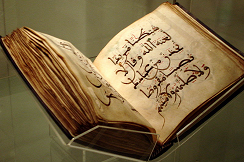
the Qur'anIn Muslim theology, the Qur’an is a verbatim incarnation of God’s word. It is an extension of divine essence and a part of eternity. In Christian theology, Jesus fulfills that role. While to most Christians the Bible is divinely inspired and miraculously without error, it is not an extension of God’s essence. The Bible quotes God, but it is not word for word in every word a direct quote from the mouth of God.

Christians believe that Jesus is divine (John 10:30-33), so that every word of Jesus is a word straight from the mouth of God. That is how Muslims view the Qur’an. Christians believe that the Bible is divinely provided and protected in order to show us Jesus (John 5:39). Muslims believe that about Muhammad. They believe Muhammad was divinely provided and protected in order to give us the Qur’an.

As a result, in Muslim theology, burning a Qur’an would be like crucifying Christ or desecrating the Eucharist. Burning a Qur’an is exponentially more explosive than burning a Bible. In Indonesia, I saw a man die in a hospital from a beating after he’d been arrested for allegedly burning some verses of the Qur’an that were supposedly mixed in with some magic charms that he was burning. In Christian theology, burning the Bible is like burning a valuable and special book, but it is nothing to Christians like burning a Qur’an is to Muslims. Functionally, for their respective groups, the Bible and the Qur’an are different, so the responses of the respective groups are different as well.

Functionally, the Muslim equivalent to the Christian Bible is Muhammad as he is known through their hadith and sunnah.

The hadith are written records of the sayings and actions of Muhammad. The sunnah is the “way” of Muhammad that the hadith reveals. Without knowing the “way” of Muhammad, there can be no authoritative application of the Qur’an. Similarly, without the Bible, there can be no authoritative knowledge of Christ.

Muslims do not study the Qur’an devotionally the way that Christians study the Bible. Rather, what Muslims study devotionally is the life of Muhammad. Muslims find life lessons in the way that Muhammad conversed, ate, drank, slept, washed, and even had sex. Muhammad is devotionally equivalent to the Bible, not the Qur’an.

Muslim clerics are legal scholars as well as theological ones. Muslim people leave interpreting the Qur’an to trained clerics the way that Americans leave interpreting the Constitution to trained lawyers. Muslims often memorize large portions of the Qur’an. But memorizing the Qur’an does not give one authority to interpret and apply it any more than memorizing the U.S. Constitution gives one credentials for practicing constitutional law.

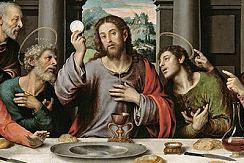
Jesus at the last supperFor Christians, their ruler is Jesus. Though he rules a heavenly rather than an earthly kingdom, he still rules. Christians call Jesus their Lord as well as their Savior. The Muslim equivalent to Jesus is the Qur’an. Muslims are devoted to the Qur’an the way that Christians are devoted to Jesus, and they treat it legally the way that Americans treat the U.S. Constitution. The Qur’an is a Muslim’s highest sovereign in the same way that Jesus is a Christian’s highest sovereign.

This post has been about the form that God uses to communicate with people. Both Christianity and Islam have prophets and scriptures; however, those prophets and scriptures don’t correlate with one another. Christians revere the man Jesus as the essence of God, whom they receive and understand through the Bible. Muslims revere the Qur’an as an essence of god, which they receive and understand through their prophet Muhammad. Functionally Muhammad correlates to the Bible and the Qur’an correlates to Jesus. Correlating Jesus with Muhammad and the Bible with the Qur’an is a mistake for Muslims trying to understand Christianity and for Christians trying to understand Islam.

That concludes this blog series comparing the implications of Muslim and Christian beliefs on God, man, nature, salvation, the future, and revelation. Many more comparisons could be made. The two religions are very different from each other.

It’s important for Christians not to fall into the popular trap of allowing people who have no religious affiliation to treat Christianity and Islam as if they were the same. If Christianity and Islam are essentially the same, then their fundamentalists are the same as well. One of the biggest challenges to religious freedom for Evangelicals in America comes not from Muslims, but from people with no religious affiliation, who will inevitably treat Evangelicals as if they were the same threat to civic order as extremist Muslims.

Link through the chart to other posts on the social impact of Muslim and Christian theology:

Return to Navigation Chart

What Do Muslims and Christians Believe Differently About the Future?

(Sixth in a series comparing the social impact of theological differences between Christianity and Islam)

Islam teaches that Muhammad established an ideal society under Muslim law when he ran the government in Medina and eventually in Mecca. Most Muslims desire to return to that ideal by implementing Muslim law as closely as possible to the way that Muhammad would apply it under conditions that exist today.

Christianity teaches, on the other hand that, since the rebellion of mankind against God by Adam and Eve in the long-gone Garden of Eden, ideal civilization is impossible unless God establishes it himself. Christians believe Jesus is God, and they believe that Jesus will return to earth from heaven some day. Therefore, Christianity teaches that God will establish the ideal society on earth through Jesus. Christian waiting for Jesus is patient but not idle. Christians believe, that while Jesus is gone they should do the best at what they think Jesus would do, but they do not believe it is possible to have an ideal society without Jesus.

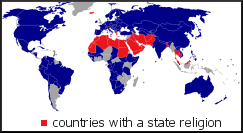
countries with a state religionThese different visions for the future lead to different ways that Christians and Muslims engage in politics. Christians try to influence government and politics, but they no longer try to establish a theocratic government as the Byzantine emperors attempted from the fourth to the eleventh centuries. Jesus taught that his dominion was spiritual and non-material. He told the Roman governor who ordered his crucifixion, that if his kingdom had been of this world his followers would have been fighting for him (John 18:36). He told the Jewish leaders who wanted to rebel against Rome to pay their Roman taxes. He said “give to Caesar what is Caesars’ and to God what is God’s” (Matthew 22:17-21). This teaching from Jesus establishes the concept in Christian theology for of a separation of powers between church and state.

Muslim theology has no such church-state separation paradigm. The Muslim ideal strives for uniting political and religious power rather than separating those powers.

Nation states and empires are inevitably violent. Governments arm policemen, field armies, and produce weapons, not priests and imams or mosques and churches. And governments use those armies and weapons to violently defend or advance their ideologies. The United States of America defends and advances democracy with great violence.

When Christians have been violent (as in the Crusades, the Inquisition, and today’s “war on terror”), it is for political rather than religious reasons. But today’s violent Muslim non-state actors are violent precisely because they are attempting to establish a Muslim state. It’s not Islam as a religion that is violent, but Islam as a political system. And because the Muslim ideal is a Muslim state, Islam will always be violent, because states will always be violent.

Christianity grew and thrived for over three centuries as a persecuted religion in both Roman and Persian empires. But, as Bernard Lewis writes in his book What Went Wrong (published by Oxford University Press in 2002),

What Went Wrong Book“Muhammad achieved victory and triumph in his own lifetime. He conquered his promised land, and created his own state, of which he himself was supreme sovereign. As such, he promulgated laws, dispensed justice, levied taxes, raised armies, made war, and made peace. In a word, he ruled, and the story of his decisions and actions as ruler is sanctified in Muslim scripture and amplified in Muslim tradition” (p. 101).

Lewis also notes,

“The idea that any group or persons, any kind of activities, any part of human life is in any sense outside the scope of religious law and jurisdiction is alien to Muslim thought. There is, for example, no distinction between cannon law and civil law, between the law of the church and the law of the state, crucial in Christian history. There is only a single law, shari’a, accepted by Muslims as of divine origin and regulating all aspects of human life: civil, commercial, criminal, constitutional, as well as matters more specifically concerned with religion in the limited, Christian sense of that word” (p. 100).

This post has covered differences between Muslim and Christian beliefs about future world civilization. Both Christianity and Islam are idealistic and triumphal, however, Christians believe that only Jesus can establish an ideal society while Muslims strive for an ideal civilization on the earth through Muslim government and law. The results of these theological differences play out everywhere on the world stage. Politicians and diplomats ignore or minimize these differences to their peril. The next post in this series will explore Muslim and Christian differences in beliefs about divine revelation.

Link through the chart to other posts on the social impact of Muslim and Christian theology:

Return to Navigation Chart

What do Muslims and Christians Believe Differently about Salvation?

(Fifth in a series comparing the social impact of theological differences between Christianity and Islam)

My last post covered implications of the differences between Islam and Christianity over how mankind relates to nature. This post will cover implications of the differences over how mankind relates to God.

For God so loved the worldIn both Christianity and Islam salvation depends upon an exclusive faith-based identity. Muslims believe that forgiveness comes exclusively through Islam, and Christians believe that forgiveness comes exclusively through Jesus (John 14:6). The similarity stops there. Muslims believe in two angels (the two kiraman katibin) who record good and bad deeds, words, feelings, and thoughts. Going to heaven instead of hell depends upon being a Muslim and upon God’s mercy in evaluating the record of one’s good and bad deeds and intentions.

In Christianity, people cannot mitigate their own sin with good words and deeds. Only God can mitigate sin. Theologians call the process “atonement.” It happens through the historical sacrificial death of Jesus Christ. God forgives sins, people repent, and a broken relationship with God gets restored. Repentance for Christians involves confessing and taking responsibility for sins, and then turning away from sin through the regenerating power of the Holy Spirit. Christians call this “salvation by grace through faith not of works” (Ephesians 2:8-9). It means salvation is not affected by good deeds but is a free gift to all who reconcile with God through a faith allegiance to the identity and work of Jesus Christ. Because forgiveness starts with God and is guaranteed by God, Christians have assurance that God won’t punish them when they confess their sins (1 John 1:9). From a relational point of view, forgiveness is not yet a relationship. Forgiveness merely forgoes the right to demand justice, punishment, or restitution. It’s half of reconciliation. The other half is repentance.

relating to God and manThe concept that people relate to one another based upon the way that they relate to God is part of Christian tradition. Jesus taught his followers that they were to forgive one another just as graciously as their heavenly Father had forgiven them (Matthew 6:12-15). People in societies following the pattern for reconciliation set by God in Jesus Christ, expect to be forgiven when they repent – when they take responsibility and promise to change. They expect mitigated consequences when they sincerely apologize.

People in Muslim societies rarely apologize as an initial step towards reconciliation. Rather, the offender will usually work on restitution and try to reestablish relationship first. Think about it. If forgiveness from god is affected by merit, then forgiveness from one’s neighbor will be too. The more responsibility one accepts for an offense, then the higher the price of restitution. Muslims will often ask for forgiveness without admitting responsibility. Muslims who want to be in relationship will often mutually blame uncontrollable circumstances, someone else, or even god as a way to reduce the price for restoring the balance of good and bad deeds between them.

Based upon these patterns, apologizing for accidentally burning Qur’ans or for the existence of videos and cartoons that insult Muhammad is a mistake. So is apologizing for past offenses like the Crusades or Colonialism. It’s like a doctor apologizing for accidentally sewing his scissors into a patient after removing an appendix. It just increases liability and the cost of settlement. Islam is a legal system as well as a religion. Forgiveness is earned. It may or may not follow restitution. Apologizing admits responsibility, so the more abject the apology, the greater the admission of responsibility, and the greater the responsibility, then the costlier the settlement.

Also, among Muslims, potential for reconciliation is higher for insiders than for outsiders. In Christian theology of salvation, people reconcile with God first, and then they become “true” Christians. In Muslim salvation, people become “true” Muslims first, and then they can be reconciled with god. The Christian God treats everyone the same. He offers forgiveness to everyone, whether Christian or non-Christian. The Muslim god treats Muslims and non-Muslims differently. Like their god, Muslims treat insiders and outsiders differently.

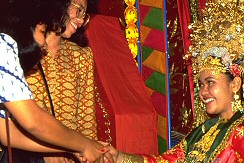
Maaf lahir batinActually, Muslims often ask each other for forgiveness. In fact, requesting forgiveness from friends and relatives is an important component of Muslim holiday celebrations. In Muslim cultures, however, maturity and good character don’t require admitting faults or taking personal responsibility for mistakes. Offenses are often forgiven without anyone ever admitting guilt. It’s like a legal settlement in court or no-fault insurance where money changes hands but no one admits that they were wrong.

From a Muslim perspective, it is the Christian pattern for reconciliation that miscarries justice. It requires that the offended party be ready and willing to forgive once a sincere apology is offered. It means you don’t actually need to do anything in order to be forgiven. It means that even the wickedest person can reconcile with God and have absolute certainty of eternal salvation. And it puts the offender rather than the offended in control. Ultimately, it appears to turn justice and divine sovereignty upside down.

This post has covered differences between Muslim and Christian beliefs about salvation. Christians believe that salvation to eternal life flows from a restored relationship with God through forgiveness and repentance that makes one a Christian. Muslims believe salvation into paradise happens only for Muslims as God mercifully considers their good and bad deeds. These differences profoundly influence human relationships resulting in different behaviors and social structures. In interpersonal relationships, Christians are expected to grant forgiveness for sincere apologies while Muslims grant forgiveness when it is earned.

The next post in this series will explore Muslim and Christian differences in beliefs about the future.

Link through the chart to other posts on the social impact of Muslim and Christian theology:

Return to Navigation Chart

What do Muslims and Christians believe differently about nature?

(Fourth in a series comparing the social impact of theological differences between Christianity and Islam)

My last post compared and contrasted Muslim and Christian beliefs about man. This post will show how different beliefs about man result in different beliefs about man’s relationship to nature.

In the Christian Scriptures it is written that on the sixth day of creation God said, “Let us make man in our image, in our likeness, and let them rule over the fish of the sea and the birds of the air, over the livestock, over all the earth, and over all the creatures that move along the ground” (Genesis 1:26). In Christian thought, this Scripture teaches that God wants man be his steward of creation.

Furthermore, in the Christian gospels it is written that Jesus healed the sick, raised the dead, and calmed the storm (Acts 2:22). Now, for Christians, Jesus is the behavior (way), character (truth), and will (life) of God incarnated into human flesh (John 14:6). Jesus demonstrates the will of God for mankind (John 20:21). Therefore, Christians believe that fighting against sickness, death, and natural disasters is fighting against evil and is according to the will of God. As a result, Western civilization has a rich heritage of struggling to improve and prolong human life with medical care, emergency services, community development, and disaster relief.

Most of the world, and particularly most of the Muslim world, does not share this passion for excellence and constant improvement in medical care, emergency services, community development, and disaster relief. A natural disaster anywhere in the Muslim world almost always kills far more people than an equivalent disaster somewhere in the Western world.

pool in Padang, IndonesiaWhen I was living among Muslims in Indonesia, I saved a man from drowning by performing mouth-to-mouth artificial respiration on him. The lifeguards at the pool had been performing the long discredited back-pressure-arm-lift method of resuscitation. I got him breathing again but not back to full consciousness, so he had to be taken to the hospital where the doctors and nurses thought that I had sucked the water out of his lungs in order to revive him. An article in the paper the next day said that fortunately for the young man a foreigner happened to be there to give him assisted breathing while removing the water that he had swallowed.

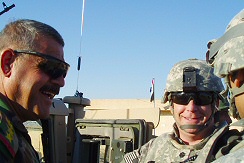
While serving among embedded military advisors in Iraq, I observed that it was very difficult for American advisors to persuade Iraqi soldiers and military leaders to wear protective equipment, like eye protection, body armor, and helmets during combat operations. The Iraqi response was always, “Insyallah,” which means “if God wills.” They seemed to be saying that whether they lived or died was God’s will so that they did not need to bother with wearing protective equipment.

military advisors in IraqThe word “Islam” comes from the Arabic root word “Salema” which means peace, purity, submission and obedience. At its essence, Islam is submission to the will of God and obedience to His law.

From the Muslim perspective, every phenomenon in the world, other than man, is administered totally by God-made laws. All of nature obeys God and submits to his will. It is said to be in the “State of Islam.”

That is different than the Christian view. The apostle Paul writes in his letter to the Romans that all of creation is in bondage to decay and waits patiently for restoration through the ones who are becoming children of God (Romans 8:20-22).

If nature is in a state of submission to the will of God, then that means that sickness, death, and natural disasters are according to his will. According to Muslim thinking, only human beings have the capacity to rebel against the will of God. Mankind is invited to submit to the will of god and to obey god’s law through the religion of Islam. Muslims believe that submission to the good will of god, together with obedience to his beneficial law is the best safeguard for man’s peace and harmony.

The logical extrapolation of this thinking is that resisting forces of nature that manifest themselves in sickness, death, and natural disaster is equivalent to resisting the will of God. Wearing protective equipment or being skilled in the latest techniques for resuscitating drowning victims reveals a lack of spirituality and a lack of submission to God’s will.

In the Christian view, nature itself has been disturbed by evil, and one of God’s purposes for humanity is not only to struggle against evil in oneself, but also to struggle against evil in nature. In the Muslim view, however, God completely controls all of nature.

Islam does call upon humanity to struggle. The word for struggle is “jihad.” Muslims are called to jihad against everything that sets itself up against the will and law of god. Jihad can be an internal personal struggle against sin, and it can be an external communal defense of Islam. But Muslims are not called to jihad against death, sickness, and natural disasters the way that Christians are. Nature, for the Muslim, is still under the control and will of God.

This blog has covered differences between Muslim and Christian beliefs about the nature of creation and man’s relationship to it. The next in this series will explore differences in beliefs about man’s relationship to God.

Link through the chart to other posts on the social impact of Muslim and Christian theology:

Return to Navigation Chart

What do Muslims and Christians believe differently about God?

(Second in a series comparing the social impact of theological differences between Christianity and Islam)

Based on the thesis that people become like what they worship, and people relate to one another based upon the way that they relate to God, in this blog series I intend to compare and contrast the social impact of Muslim and Christian beliefs about God, man, nature, salvation, end times, and revelation. This entry compares and contrasts the social impact of Muslim and Christian beliefs about God.

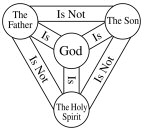
the Christian TrinityThe Christian God is three persons in one essence, while the Muslim god is a single autonomous unity. The English technical term for the three-in-one Christian God is “trinity.” The Arabic technical term for solitary singularity of divine essence is tawhid.

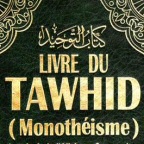
the Muslim TawhidMuslim scholars claim that tawhid is the most important article of Muslim faith and that all other Muslim doctrine springs from it. Tahwid means not only that there is only one God, but also that nothing in creation can be associated with God and that God cannot associate himself with anything in creation. We’ll explore the implications of divine non-association in my next post on the theology of man, but for now let’s consider the implications for society and civic structures if God is a singularity rather than a trinity.

In chapter one of He Is There and He Is Not Silent Francis Schaefer writes,

The Persons of the Trinity communicated with each other and loved each other before the creation of the world…. This is not only an answer to the acute philosophic need of unity in diversity, but of personal unity and diversity. The unity and diversity cannot exist before God or be behind God, because whatever is farthest back is God. But with the doctrine of the Trinity, the unity and diversity is God Himself — three Persons, yet one God. That is what the Trinity is, and nothing less than this

Honor, glory, love, integrity, morality, and truth demand relationships. These moral qualities cannot exist within a singularity. However, these moral qualities can exist in eternity past within a trinity. If God is a trinity, then glory, honor, and love are eternal. That eternity for glory, honor, and love is possible because the persons of the trinity have been glorifying, honoring, and loving each other for eternity. Also, if God is a trinity, then integrity, morality and truth are also eternal. That eternity for moral qualities is possible because the persons of the trinity have been holding each other accountable to standards of integrity, morality, and truth for eternity.

But if God is a singularity, then there are no interpersonal relationships within God. If there are no interpersonal relationships within God, then there is no eternal basis within God for honor, glory, love, integrity, morality, and truth. If there is no basis in eternal reality for God’s glory and honor, then God’s glory and honor are not eternally innate to him but depend on his relationship with creation. Also, if God is a singularity, then God can do nothing to shame himself. If God has no innate honor, then he can never potentially have innate shame. He can only be shamed by his creation. If God can do nothing to potentially shame himself, then his behavior has no moral boundaries. He can lie, cheat, and steal with impunity because God is only accountable to himself. If there are no relationships within God, then God has no accountability.

In Christian society, because God is a trinity, nothing and no one can embarrass or dishonor God. God’s honor and glory are part of his eternal essence and depend on nothing other than God himself. Nothing in creation can ever change or diminish God’s honor and glory — even if God becomes a man and dies a humiliating death on a cross. Only God himself can potentially shame himself, because a trinity has accountability within itself.

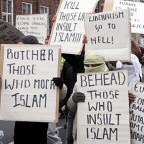
insulting islam shames GodBut in Muslim society, because god is a singularity, the society must guard and protect his glory. Nowhere on earth and at no time in history do we find Christians violently protesting in the streets when people insult God, his prophet, or his holy books. People in Christian societies know that God does not need his honor protected. But Muslims around the world throughout history are paranoid about the glory of their god. “Allah Akhbar,” the Arabic words for “God is Great,” are constantly on their lips. Insulting the prophet receives a death penalty in many Muslim countries. Defiling a Qur’an instigates violent protests and even murders around the world.

People become like what they worship and relate to one another based upon the way that they relate to God. In Christian societies, God’s honor is certain and his integrity is an innate attribute. Christian doctrine holds that God’s integrity constrains his behavior so that he cannot lie. If God were to lie, then he would shame himself. Therefore, in Christian societies, integrity is more important than honor, and society expects people to tell the truth even if it means embarrassing themselves, their families, their business, or their leaders.

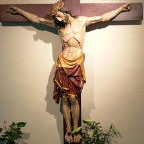
Crucifying Jesus shames himBut the relative esteem for integrity and honor are reversed in Muslim societies. According to Muslim doctrine and according to the Qur’an itself, “Allah is the best deceiver.” In Islam, god’s honor depends upon how creation treats him, and integrity is not an innate part of his eternal essence. Power, as an attribute, can be independent of relationships, and it is the most vaunted attribute of the Muslim god. As a result, in Muslim societies, honor is more desirable than integrity, and people are expected to deceive in order to protect themselves, their families, their businesses, or their leaders from shame. Among Muslims, the notion that God would stoop to become a man and suffer at the hands of men is one of the most offensive blasphemies to comprehend.

Because of tahwid the Muslim god can only be dishonored by his creation, and he cannot dishonor himself. However, because of the trinity the Christian God can only be dishonored by himself and cannot be dishonored by creation. As a result, Christian societies do not worry about protecting God’s honor and care more about truth than honor, but Muslim societies are paranoid about god’s honor and care more about honor than truth.

Link through the chart to other posts on the social impact of Muslim and Christian theology:

Return to Navigation Chart

Are Islam and Christianity different and does it matter?

civic structures and religionThis is the first in a series comparing the social impact of theological differences between Christianity and Islam.

I believe that people become like what they worship, and people relate to one another based upon the way that they relate to God. If religions matter and if religions are different, then different civic structures will emerge from different religions. But popular culture resists information that challenges its prevailing conviction that all religions are basically the same. It sees what it expects, and it overlooks what it doesn’t.

Recent research shows that the religion of “no-religious-affiliation” is the fastest growing religious position in America. This group’s influence on popular thought throughout all of America is stunningly profound. If religion is irrelevant, then all religions are basically the same. And if all religions are basically the same, then different religions do not result in different civic structures, and civic structures become interchangeable between societies that are practicing different religions.

This emerging belief system impacts both secular and Christian institutions. On the secular side, it is the foundation for the failure of peacekeeping efforts in the Middle East and Central Asia. On the Christian side, it undergirds efforts to create a Jesus movement within Islam.

In this series, I will challenge conventional popular wisdom about religion. I will demonstrate that Islam and Christianity are fundamentally different. I will compare and contrast Muslim and Christian beliefs about God (theology), man (anthropology), nature (cosmology), salvation (soteriology), end-times (eschatology), and revelation. I will show how different beliefs result in different values that result in different social behaviors.

On the secular side, Western civic structures are founded in a Judeo-Christian religious heritage. Conversely, Middle Eastern and Central Asian civic structures are founded in a Muslim heritage. Civic structures cannot survive without underlying values that are based upon popular beliefs. Structure for government, justice, education, public works, civil defense, marriage, family, and more must have points of contact with underlying values. Structures functioning in one religious heritage cannot survive inside another without adapting so that they have points of contact in the values based on the beliefs of the other system. Such adaptation is not possible when the people attempting to transplant the structures believe that all religions are basically the same.

On the religious side, not everyone who professes to be a Christian is truly following Jesus and is “saved” according to an Evangelical perspective. Furthermore, some people who call themselves Muslims are actually or secretly following Jesus. As a result, many Evangelicals are embracing the popular notion that Muslims and Christians worship the same God. That leads to religious structures being interchangeable. It means that Muslims can follow Jesus and remain in Islam while Christians can worship in Mosques and celebrate Muslim holidays without committing idolatry. But if the Muslim and Christian gods are different, then worshipping in a Mosque would be idolatry for someone following Jesus, and worshipping in a church would be idolatry for someone following Muhammad.

Follow this series and then decide for yourself. Can Western civic structures bring peace and prosperity to the world of Islam? Can Muslims follow Jesus and remain inside Islam?

Link through the chart to other posts on the social impact of Muslim and Christian theology:

Return to Navigation Chart

Prognosis for Minorities Under Middle Eastern Democracy

signs of minorities in Egypt As a tidal wave for democracy washes across the Middle East, how might Middle Eastern democracies look?

In 2003, while advocating for change in Iraq, President Bush asked, “Are the peoples of the Middle East somehow beyond the reach of liberty? Are they never to know freedom?” In his 2009 Cairo speech, President Obama underscored his “commitment . . . to governments that reflect the will of the people.” He claimed, “But this much is clear: governments that protect these rights are ultimately more stable, successful and secure.”

Most American foreign policy experts believe that democracies will not fight each other, so, therefore, spreading democracy spreads peace. However, democracy may not be good for everybody. American democracy did not help black slaves or Native Americans for at least a hundred years. Barack Obama may have been thinking of this history when he clarified at Cairo, “And we will welcome all elected, peaceful governments – provided they govern with respect for all their people.”

How might democracy in a place like Egypt look for all the people?

A Pew Opinion Survey published in December 2010 found that 82 percent of Muslim Egyptians favor stoning for adultery, 77 percent favor severing limbs for theft, and 84 percent favor death for apostasy (leaving Islam).

“How can this be?” asked a friend. “We think of Egypt as being more educated and modern.” We also believe that only a tiny fraction of Muslims are radical. How can the vast majority of Muslims in moderate Egypt embrace capital punishment for people who leave Islam?

The obvious answer lies so far outside of American experience that it’s not seriously considered. Islam is a political system as well as a religious one. Leaving Islam is treason. Even in the USA, treason is punishable by death. Popularity of the death penalty for leaving Islam proves that Islam is a political system. Popular support for freedom of conscience and expression in Islam evaporates like popular support for sedition in America. Politics and Islam are functionally the same.

Violence is a tool of the state. America defends and propagates its ideology both at home and abroad with violence. American soldiers in Iraq and in Afghanistan are state instruments for defending and propagating democracy.

Religions become violent when they become political ideologies. That’s why so many Europeans emigrated and founded America. They wanted to be free from the mixing of religion and politics that motivated Crusades and Inquisitions.

Religion without politics is mostly benign. However, government is never without access to violent tools. Atheistic dictators Stalin, Mao, and Pol Pot demonstrate the potential for violence in political systems without religion. The common denominator in nearly all violence is politics.

Today, Americans have lived for so long under a system that separates church and state that they have lost touch with how most of the world still integrates politics and religion. In Indonesia, it is illegal to be an atheist. In China, many pastors are in jail for leading non-approved congregations. In Pakistan, blasphemy – defined as criticizing Mohamed – is a capital offense. Many Americans have so lost touch that they actually blame religion, rather than politics, for more violence.

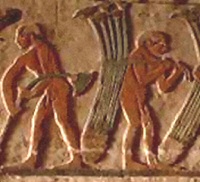
minorities in ancient Egypt Now back to Egypt. In a country that is 87 percent Muslim, of whom at least 80 percent follow Islam as a political system, consensus will likely implement Muslim faith with civil law.

American history demonstrates how democracy is great for the majority, but not necessarily so great for minorities. Brutality in displacing Native Americans along with slavery and discriminatory segregation underscore this inescapable reality.

In an Egypt under majority rather than dictatorial rule, religious minorities will be like African Americans and Native Americans before the American civil rights movement. Majority rule in Egypt will not be very pretty for non-Muslim minorities. Not until Muslims begin separating their politics and religion.

Authentic Islam Seen on YouTube

The Islam on YouTube is filled with divergence and disagreement revealing Muslims are in a desperate search for authentic values and lifestyles. Do not be satisfied with drinking in what others say about Islam or what Muslims say about themselves. Learn from the raw material of  what Muslims say to and about each other. YouTube presents a glorious window into the world of art, music and instruction by Muslims for Muslims.

Here are some examples:

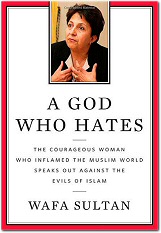
Book Review: A God Who Hates, by Wafa Sultan

book imageShe rocked the Muslim world with interviews on Al-Jazeera in 2006. In A God Who Hates, Syrian-born Wafa Sultan disturbingly and unwittingly exposes a deity with the character of the snake (Genesis 3:15) and the dragon (Revelation 12) that hates the gender and the race that produced the Redeemer. She has some good sociological insights on why Muslim women endure oppression and how Arab Islam is unique in Islam. She is on a journey. Her book is insightful but disturbing and not to be digested uncritically. Her work is experiential and anecdotal, but also courageous and revealing.

Landscape of Islam

Printable pdf Version

The clickable charts below overview a complex topography of competing Muslim institutions and complex trans-institutional Muslim movements.

Institutional Development of Islam

Click different regions to learn more about sects and movements in Islam.
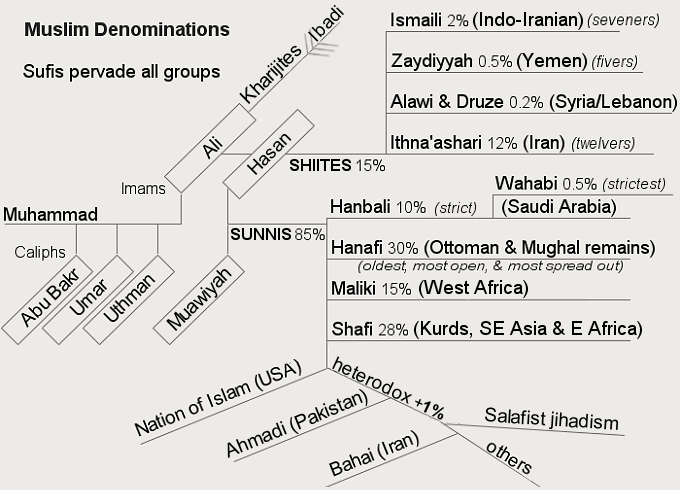
Denominations in Islam

The diagram below illustrates

Diversity Within Muslim Institutions

Two individuals in different denominations may be more alike than two individuals in the same. Regrouping along these five different sliding scales produces the modern movements within Islam that are creating tension and new institutions.

Click different regions to learn more.
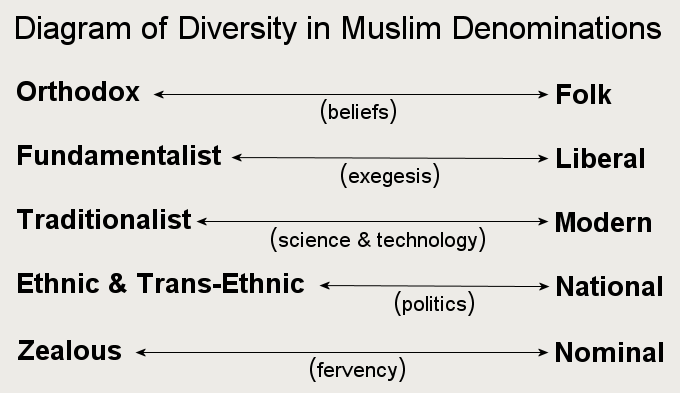
Diversity in Denominations

Belief Scale – Orthodox to Folk:

In Indonesia our house helper warned us to hang a clove of garlic around the neck of our 6-month old son whenever we might take him with us into the market. A few miles from our house, the tomb of the missionary who’d established Islam in that part of Indonesia attracted everyone from barren women praying for a child to students praying to pass exams. What most educated Americans consider superstition affects most Muslim lives more than the five ritual “pillars” of Islam. Charms of the evil eye and the hand of Fatima abound even in modern Turkey. Saddam Hussein had reportedly worked some magic that would protect him from bullets. Scholars call these expressions “Folk Islam.” Many clerics claim the Qur’an forbids Folk Islam and the beliefs attached to it. In the early 1800s, Wahabi-influenced pilgrims returning from Mecca started a war in Sumatra against the traditional aristocracy to purge heterodox folk practices. Similar sentiment impacts many today. On the belief scale, most Muslims lean folk. Most religious leaders lean orthodox. . (Back to Diagram)

Exegesis Scale – Fundamentalist to Liberal:

After 9-11 on September 16th, Al-Muhajiroun released a statement to the press praising the Taliban for their work towards establishing Shari’a. It called upon all Muslims to support them. Two days later, the flagship English language newspaper of Bangladesh ran an article saying that no true Muslims anywhere can support such terrorism because “Islam is a religion of peace.” The difference in these two statements flows from methods of interpreting scriptures. For exegetical fundamentalists, scripture is “the” authority to be taken at face value and interpreted independent of cultural context and history. For exegetical liberals, scripture is “an” authority to be balanced with knowledge from other sources. Strong liberals prefer allegorical and figurative interpretations. Strong fundamentalists prefer literal ones. In Surah 9 verse 5, the Qur’an says to slay, capture, besiege, and ambush non-Muslims unless they repent and submit. At the fundamentalist extreme, this verse calls for jihad against Americans and Jews. A more liberal approach studies the context and discerns that this verse should not be applied in that way. Irshad Manji sits at the liberal end of the exegesis scale. She is a Muslim, a Canadian, a speaker, and an author. She produced and hosted the Gemini award-winning show QueerTelevision, and she is lesbian. Osama bin-Laden sits at the other extreme. Most Muslims are in the middle. Most political leaders lean liberal. Most common people lean fundamentalist. Religious leaders span the whole spectrum. (Back to Diagram)

Science & Technology Scale – Traditionalist to Modern:

Extremes on this scale become most apparent in the fields of medicine and education. In Indonesia, when they got sick, some of our friends turned first to herbal cures and witch doctors. Others turned first to state-of-the art imported medical technology. Some sent their children to boarding schools with European style curriculum. Others boarded their children at schools committed to the conviction that everything anyone ever needed to know was in the Qur’an. Nahdlatul Ulama (NU) is the largest religious organization in Indonesia and one of the largest of its kind in the world. It leans traditionalist. Its schools follow the traditional pesantren Muslim boarding school model. They teach religion as traditionally taught and practiced in Indonesia. Many of its leaders practice a pre-Islamic Javanese mysticism called Kebatinan. Modernist leaning Muslims would consider it to be vain superstition. Before its national assembly meetings, NU has been known to sponsor an exorcism of the facilities. Muhammadiyah is Indonesia’s second largest religious organization. It leans more modern. Its schools are more European in style, curriculum, and methods. It opposes unorthodox syncretism to pre-Islamic beliefs and practices while embracing a more modern view on gender equality. It seeks to reform Islam, as it has been traditionally taught by the ulema, in order to to make it more relevant in the modern world. On the scales addressed so far, NU leans folk, liberal, and traditionalist. Muhamadiyah leans orthodox, liberal, and modern. On the remaining two scales, both emphasize nationalism and fervency. (Back to Diagram)

Political Scale – Ethnic/Trans-Ethnic to National:

Position on this scale depends on personal identity and group allegiance. Heads of state as well as nearly all politicians and government workers land solidly at the national end. Translators working with coalition forces to stabilize Afghanistan and Iraq land on the national end as well. At the opposite extreme would be someone like bin-Laden who cares nothing about either political borders or ethnicity. He envisions an imperial Islam, like in the days of old, transcending ethnic identities and nation-state boundaries. For many Muslims, like for most Kurds, ethnic and tribal identities transcend both national and religious ones. Among many Muslims, ethnicity and religion cannot be separated. The name Minangkabau for a tribe in Indonesia means “winning buffalo.” Minangkabau people say that if a Minangkabau person leaves Islam, all that remains is the buffalo. The saying means that when a Minangkabau person leaves Islam, that individual ceases to be a person in the ethnic group. (Back to Diagram)

Fervency Scale – Zealous to Nominal:

The vast majority of Muslims are peaceful, and, “co”-incidentally, the vast majority of Muslims are nominal. Of the two billion people who claim to be Christians only a very small percent attend church regularly or give sacrificially to religious causes. The same is true for one billion Muslims. The percent faithfully keeping the pillars and sacrificially donating to charities is small. Being zealous does not equal resorting to violence, but it heightens that risk. Fortunately, Jesus understood human nature enough to teach strongly against violence in his name, and he set a solid example of non-violence. Historically, many Christians still have not followed his example. I am not qualified to teach about Islam or the life of Muhammad, and I will not do that. I can, however, teach about Jesus, current events, and history. Around the world we see that when Muslims turn zealous because they have been offended over something like cartoons of Muhammad, they often resort in very large numbers to using violence in the name of Islam. Being zealous in a faith does not make one violent in that faith’s name, but the tendency to violence in the name of a religion will be higher among the zealous believers than among the nominal ones. (Back to Diagram)

Muhammad (570-632):

He is the founder of Islam. Muslims regard him as the last and greatest of four prophets who dictated divine scriptures. The other three were Moses, David, and Jesus who delivered the Taurat, Zabur, and Injeel respectively. Mohammad revealed the Qur’an, the supposed last and only undistorted scriptures available today. He and his followers were persecuted in Mecca. In 622, he and his followers fled to Medina. This event marks the beginning of the shorter lunar Muslim calendar year. In Medina, Muhammad established his political as well as religious rule. In 630, he returned with a larger following to conquer Mecca and unite the Arab tribes under Islam as a religious and political system. He died from illness in 632. Muhammad’s closest followers (and followers of those followers) recorded his non-revelatory acts and sayings. These writings are called Hadiths. They establish precedents for interpreting the Qur’an into Shari’a law. (Back to Chart)
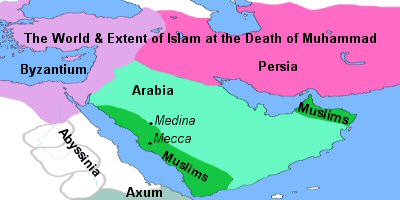
 

World Politics in 632

Abu Bakr (573-634):

He was the father of Muhammad’s third and favorite wife, Aisha. He was a close companion and advisor to Muhammad. He subdued rebelling tribes at Muhammad’s death in 632 and ruled as Islam’s first Caliph until his death from illness in 634. He compiled the Qur’an from various scraps of paper and other materials upon which Muhammad’s revelations had been written. He then forbid revising his “authorized” copy. He invaded Sassanid Persian and Byzantine empires. He expanded the emerging Caliphate into parts of modern Syria and Iraq. (Back to Chart)
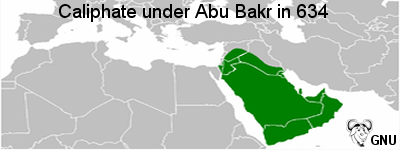
Caliphate under Abu Bakr

Umar a.k.a. Omar (c. 590-644):

He took over as the second Caliph the day that Abu Bakr died in 634. He had been a close companion of Muhammad. He was an expert jurist and military commander. He became one of history’s greatest political geniuses. He expanded the Caliphate taking over the whole of the Persian Empire and two-thirds of the Byzantine Empire. Many non-conforming Christian groups (i.e. Maronites, Jacobites, Copts, Nestorians) initially welcomed the Arab liberation from Byzantine intolerance. He laid the foundation for administrating non-Muslim majorities that preserved Muslim imperial expansion. He developed a reputation for ruling justly over Muslims and non-Muslims alike. For example, he allowed Jews to live and practice Judaism in Jerusalem where it had been forbidden for 500 years. At the peak of his power in 644, he was assassinated. (Back to Chart)
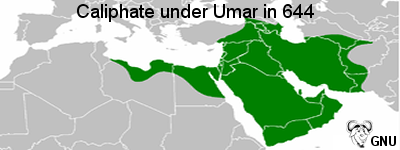
 

Caliphate under Umar

Uthman a.k.a. Usman (579-656):

He took over the growing Muslim empire as the third Caliph upon Umar’s assassination in 644. He had been a close companion of Muhammad. He expanded the Caliphate, instituted economic reforms, and expanded public works. He put down revolts in Persia, resisted attacks from Byzantium, prepared to invade Constantinople, and expanded into Crete, Sicily, Cyprus, Nubia, and the Iberian Peninsula. During his rule, differences in content of the Qur’an began to emerge in various parts of the empire. He obtained from Muhammad’s fourth wife, Hafsa, a copy of what Abu Bakr had assembled. Copies were sent to each province with orders to destroy all others. While featuring economic and military success, he faced intrigue and political unrest. In 656, rebels besieged him in his own home in Medina and assassinated him. (Back to Chart)
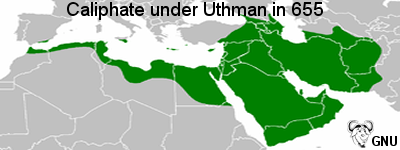
Caliphate under Uthman

Ali (c. 600-661):

Ali is Sunni Islam’s fourth Caliph and Shia Islam’s first Imam. He succeeded Uthman to become fourth Caliph in 656. He was not universally accepted as caliph, resulting in the empire’s first civil war. In 661, he accepted truce with opponents by arbitration. A member of a faction that opposed the arbitration assassinated him. Ali was both Muhammad’s cousin and son-in-law. Because of this blood relationship through which Muhammad has grandchildren, Shia Muslims accept Ali as Muhammad’s correct successor. They view Abu Bakr, Umar, and Uthman as usurpers. (Back to Chart)
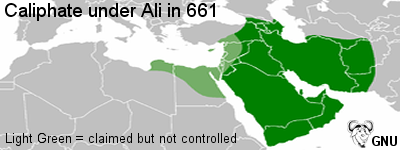
 

Caliphate under Ali

Hasan (626-669):

He is Ali’s oldest son. Muhammad is his grandfather. He reigned for less than one year in 661 as fifth Caliph. For Shiites, he is the second Imam. After a few minor skirmishes between major opposing armies, he ceded the title of Caliph to Muawiyah in exchange for peace. Hasan was poisoned by one of his wives in 669. His younger brother, Hussein, followed him as Shia Islam’s third Imam. (Back to Chart)

Muawiyah (602-680):

He was governor of Damascus and Uthman’s cousin. In 656 he contested Ali’s selection to be the fourth Caliph and instigated civil war. After Ali’s murder in 661, he took the caliphate from Ali’s oldest son, Hasan. This marked the division between Shia and Sunni Islam with Hasan heading the Shiites as their second Imam and with Muawiyah heading the Sunnis as their fifth or sixth Caliph depending upon whether or not Hasan is counted as the fifth Caliph. He founded the Umayyad caliphate, which ruled from Damascus until defeated by the Abbasids of Baghdad in 750. His dynasty governed the largest Arab-Muslim state in history and the world’s sixth largest contiguous empire ever. (Back to Chart)

Kharijites:

These are the first schismatic sect of Islam. They accepted the caliphates of Abu Bakr and Umar, but rejected and rebelled against Uthman. They initially accepted Ali, but then rejected him over his accepting the arbitration that ended the first civil war. They believe in obedience to the Caliph as long as he rules justly and piously. If not, they believe the Caliph must be confronted, deposed, or even murdered in order to be replaced. Ali’s assassin was a Kharijite. They eventually split into more than twenty sub-sects. Of these, only the Ibadi remain today. (Back to Chart)

Ibadi:

The last remaining Karijite sect. Mostly found in Oman. Smaller communities are also found in Algeria, Libya, and Zanzibar.(Back to Chart)

Caliphs:

These were heads of state and supreme religious leaders of the Muslim community ruled by the Shari’ah law. Shia Muslims reject all caliphs except Ali and Hasan. After the first four caliphs, who were personal friends of Muhammad, the title went to the members of the Umayyad (Damascus), Abbasid (Baghdad), Fatimid (Cairo), and Ottoman (Istanbul) dynasties with occasional competition from dynasties in Spain, North Africa, and Egypt. Regional governors were called sultans or emirs and ruled under the caliph. Muslims have not had a caliph since the end of the Ottoman Empire in 1924. (Back to Chart)
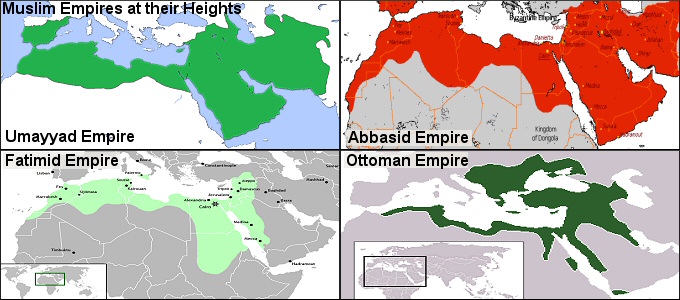
Muslim Empires

Imams:

These are the spiritual, political, and hereditary successors to Muhammad according to Shia Islam. Though human, they were infallible. They ruled with perfect justice and perfectly interpreted divine law. Their words and actions have become the model for everyone to follow. (Back to Chart)

Shiites:

The Shia faith is vast with various theological beliefs, schools of jurisprudence, philosophical beliefs, and spiritual movements. Shia Islam breaks with Sunni Islam primarily over its system for interpreting divine revelation and implementing political authority. In Shia Islam, the religious/political leaders are divinely selected and divinely inspired to infallibly interpret revelation and govern accordingly. (Back to Chart)

Ismaili:

They are called “seveners” by their detractors because they believe the Imamate ended with the seventh Imam Ismail ibn Jafar whose son disappeared to one-day apocalyptically return as the Mahdi. They also have seven rather than the five pillars of practice that are present in most other forms of Islam. They were once the largest Shiite branch. The Cairo-based Fatimid dynasty of the tenth century was Ismali. Today’s Ismalis fall into several different traditions or paths called tariqah. The largest is the Nizari path. It recognizes a living “Imam” as the 49th hereditary Imam. Though mostly Indo-Iranian in modern times, they also live in India, Pakistan, Syria, Saudi Arabia, Yemen, China, Jordan, Usbekistan, Tajikistan, Afghanistan, East Africa, and South Africa. Many have emigrated to Europe, Australia, New Zealand, and North America. (Back to Chart)

Zaidiyyah:

They are called “fivers” because they follow the teachings of a different fifth Imam named Zayd ibn Ali. They embrace all the other eleven of the Shia imams. Unlike other Shia Muslims, they don’t believe the Imams were infallible or that they received special divine guidance. The Zaidi divide into three main groups. The largest group makes up over forty percent of Yemen. One Zaidi group in northern Yemen is revolting against the central government creating a humanitarian crisis there. (Back to Chart)

Alawi:

They call themselves Shia and take their name from Ali. Orthodox Sunni Muslims consider them to be completely heretical. They keep many of their distinctive beliefs secret. They are a powerful religious minority in Syria where they control many key positions in the military and government, like the presidency. Over one million live in cities throughout Syria and another million live in neighboring regions of Turky. They are one of the eighteen recognized minorities in Lebanon where they mingle with the Druze. (Back to Chart)

Druze:

They started as an Ismaili movement during the Ismaili Fatimid dynasty early in the eleventh century. They drew heavily from Greek philosophy and Gnosticism. They opposed some major trends in the religious landscape of their day. They have always been a minority. They have been alternately used and abused by the prevailing powers, sometimes rising to prominence and sometimes suffering vicious persecution. Today they remain socially and religiously distinct. They often conceal their beliefs and identity. They forbid intermarrying. Since 1043, they have forbidden proselytizing. Worldwide their population probably reaches one million. Lebanon, Israel, and Syria treat them as a separate community with their own religious court system. They have an important role in the politics of Lebanon. In Israel, some live in separate communities while others have citizenship and have served in the armed forces. Five Druze lawmakers are serving in the 18th Knesset. Unlike most other Muslims, they reject tobacco and polygamy as well as alcohol and pork, and they believe in reincarnation. They believe rituals are purely symbolic for an individualistic effect, so the pillars of Islam are not obligatory for them. (Back to Chart)

Ithna’ashari:

They represent 85% of Shia Islam. They are called “twelvers” for adhering to a progression of twelve imams in the lineage of Muhammad through his daughter Fatimah and son-in-law Ali. The imams were chosen by God and not by human consensus. They infallibly interpreted and applied Muslim law. They reject legal precedents set by Sunni caliphs. They believe every age has a divinely selected Imam. The imam for this age is the twelfth who was born in the ninth century. He has been supernaturally preserved and hidden. He will reappear someday to establish a correct and global Islam just before the final day of judgement. This is Iran’s national ideology. Most twelvers live in Iran and spill into neighboring Iraq, Azerbaijan, and Afghanistan. Significant twelver minorities live in Saudi Arabia, Pakistan, Bahrain, Kuwait, and Lebanon. (Back to Chart)

Sunnis:

Both Shia and Sunni Muslims hold the Qur’an to be the ultimate authority for faith and practice. Both revere the acts and sayings of Muhammad (Hadith) as the key to interpreting and applying the Qur’an. Sunni and Shia Muslims differ over who gets to do the interpreting and applying. Shia Muslims conform around the identity and teachings of their imams. Sunni Muslims conform around the consensus of scholars who interpret and apply the Qur’an in accordance with what they identify as the Sunnah – the tradition of Muhammad and of the emerging Muslim community. As Shia Muslims ascribe infallibility to their imams, so Sunni Muslims ascribe infallibility to scholarly consensus, resulting in interpretations and applications that cannot be changed. Four legal traditions and three theological traditions have evolved from Sunni scholarly consensus. The legal traditions concern applying th Qur’an to everyday life. They are Hanbali, Hanafi, Maliki, and Shafi. The theological traditions concern the nature of God, revelation, man, and fate. These are Ash’ari, Maturidiyyah, and Athari. Ash’ari tradition emphasizes divine revelation over human reason for determining ethics, and it emphasizes divine sovereignty over free will for determining fate. Maturidiyyah tradition reverses Ash’ari emphasis by more highly esteeming human reason and free will. Athari tradition is more intuitive, anti-intellectual, and tolerant of ambiguity than the other two. (Back to Chart)
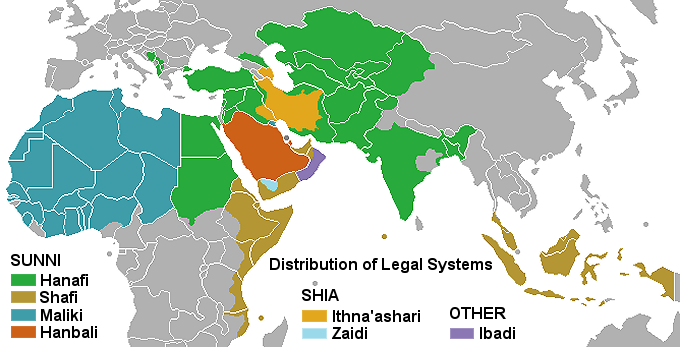
Legal Systems
See more detailed source map here.

Hanbali:

Students of Imam Ahmad bin Hanbal started this tradition around 855. It is the strictest and most literal in its approach to the Qur’an. It has the smallest number of followers. It predominates in the Arabian Peninsula. It prefers the Ash’ari theological tradition that elevates divine revelation above human reason for formulating ethics and divine sovereignty above free will for determining fate. (Back to Chart)

Wahabi:

Wahabism is the strictest sect of Hanbali Islam. It is primarily practiced in Saudi Arabia, and it is exported from there with oil profits. Abd al-Wahab started it in the 18th century. He advocated restoring Muslim practices to the days of the prophet and his imperial successors. He sought to purify Islam of syncretism and of what he considered to be later innovations. When pilgrims influenced by Wahabism returned to Indonesia in the early 1800s, they instigated revolution not only against the Dutch but also against traditional aristocracies. (Back to Chart)

Salafi jihadists:

Salafi Muslims want just like Wahabi Muslims to return to the “perfect” Islam that was practiced in the days of Muhammad and his companions. The terms Salafi and Wahbi are often used interchangeably. Salafism differs from Wahabism (and is more dangerous) by drawing from all four of the legal systems in Sunni Islam. Salafists describe themselves as “Muwahidoon”, “Ahl al-Hadith”, or “Ahl at-Tawheed” (listen for these terms). Salafists reject calling themselves Wahabists. They contend Abd al-Wahab did not go far enough because he did not restore the pure Islam. Salafis usually reject Western ideologies such as Socialism and Capitalism as well as concepts like economics, constitutions, and political parties. They seek to advance Shari’a (Muslim law) rather than a Muslim political program or state. Salafi ideology represented in Sayyid Qutb is producing schismatic jihadists like Osama bin Laden and Ayman al-Zawahiri. (Back to Chart)

Hanafi:

Followers of Abu Hanifa an-Nu’man ibn Thabit established this jurisprudence tradition around 780. It is the oldest of the four systems. It emphasizes human reason. It is the most liberal of the four schools, and it has the largest following. The Ottoman Empire ruling from Istanbul and the Mughal Empire ruling the Indian subcontinent used and spread this system. It is the most popular system nearly everywhere they ruled. (Back to Chart)

Maliki:

Two literary works by Imam Malik (711-795) inspire this jurisprudence system. It predominates in West Africa, North Africa, the United Arab Emirates, and parts of Saudi Arabia. Around fifteen percent of Muslims follow this system. It’s main distinctive comes from ascribing more weight to sources originating in Medina and precedents established there than sources and precedents derived from other early Muslim communities. (Back to Chart)

Shafi:

This is the second most widespread Muslim legal system. It’s name comes grom Imam ash-Shafi’i. His categories for legal reasoning included a secondary place for community consensus and analogy in addition to the Qur’an and Sunnah. Shafi jurisprudence is the official system for the governments of Brunei, Malaysia, and Indonesia. It is also predominates in Syria, Palestine, Lebanon, the U.A.E. Chechnya, Kurdistan, Egypt, Djibouti, Eritrea, Somalia, Yemen, Sudan, the Maldives, and Singapore. (Back to Chart)

Bahai:

This is a monotheistic faith founded in nineteenth-century Persia by a man claiming divine inspiration and the title Baha’ullah. Followers assert they follow a distinct and new religion. Most Muslim political and religious leaders do not concur. They say it is an apostate form of Islam. Followers have been severely persecuted in Iran and Egypt where their religious activities are illegal. Since Islam claims to be the last and final divine revelation, new religions are often less tolerated than old ones. Bahai followers view their heritage in Shia Islam to be similar to the heritage of Christians in Judaism. Worldwide followers number above seven million. Over two million live in India. The rest are widely distributed among all the world’s nations. Over 300,000 of them form the largest religious minority in Iran. (Back to Chart)

Ahmadi:

In the late 1800s, Mirza Ghulam Ahmad claimed to be the promised Jewish Messiah, second coming of Christ, and the Muslim Mahdi. He started the Ahmadiyya movement in British occupied India/Pakistan as a branch of Islam. His followers today claim to be Muslims leading the revival and peaceful propagation of true Islam. They predominantly live in Pakistan, Indonesia, and India. They have freedom in India, but are persecuted in Pakistan and Indonesia. Orthodox Muslims consider them heretics for embracing a prophet that followed Muhammad. (Back to Chart)

Nation of Islam:

Wallace D. Fard, a.k.a Elijah Muhammad, founded the Nation of Islam (NOI) in Detroit in 1930. He aspired to restructure the conditions of black men and women in America. He claimed to be the Mahdi of Islam and second coming of Christ. Louis Farrakhan heads the religious organization today. The NOI preaches adherence to the pillars of Islam, but its followers do not practice them in accordance with traditions in Islam. Many NOI teachings about God and mankind are not in accordance with mainstream Islam. (Back to Chart)

Sufis:

Sufism pervades every denomination of Islam at varying percent levels. It results in an inner mystical and experiential manifestation of personal spirituality that is outside of orthodox Muslim law and theology. Sufi movements span languages, cultures, continents, and a thousand years. Participants usually seek divine love and knowledge. They typically exhibit discipline and piety. They commonly use dancing, trances, chanting, and singing. They frequently venerate local saints at their tombs. Sufis are organized into brotherhoods around spiritual leaders and grouped into orders called tariqas. (Back to Chart)