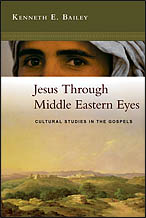
 Jesus lived and taught where most military men and women are serving. Kenneth Bailey’s book, Jesus Through Middle Eastern Eyes: Cultural Studies in the Gospels, reveals what Jesus’ life and teaching meant to his Middle Eastern audience. His impact on them was often quite different than his impact on Europeans and Americans today.
For example, according to Rolland Muller in his book The Messenger, The Message, and The Community (p. 237), parents in the Middle East today still indoctrinate their children using a story with a moral about how it is more honorable to say “yes” to your father in public even if you plan not to do what he says, than to say “no” in public and obey him later. Compare this to the parable Jesus tells that is recorded in Matthew 21:28-32. In that story, one son tells his father he will work in the vineyard but does not, and the other son tells his father he won’t work in the vineyard but does. By commending the son who publicly humiliated his father but privately obeyed him, Jesus shocks his audience in ways that we cannot comprehend.
Jesus taught in Aramaic, not Greek. Yet the original New Testament is Greek. Kenneth Bailey has spent 40 years living, studying, and teaching in Egypt, Lebanon, Jerusalem, and Cyprus. He reads ancient New Testament translations and commentaries in Aramaic. From the Greek he can reconstruct the probable words that Jesus actually spoke and estimate the understanding his audience most likely had. His insight into the teaching, context, and drama of Jesus outstrips that of the finest Bible scholars who study texts and traditions in mainly Hebrew, Greek, and Latin.
Service in the Middle East brings sparkle to the Bible through reading this book, and reading this book adds freshness to serving in the Middle East.







 http://www.faithandwar.org
 Mark Durie's Blog
 Military Missions Network
 The Christian Fighter Pilot
 The Navy Christian