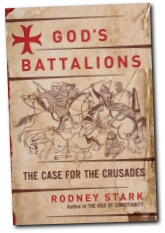
 God’s Battalions: The Case for the Crusades
by Rodney Stark
Harper Collins Publishers, 2009, paperback 288 pages
In history classes at various Army service schools I’ve learned about many military campaigns. Lectures and readings expose lessons for modern leaders from the days of Carthage down to modern times. However, for some mysterious reason, military history curriculums ignore the two centuries containing the Crusades.
The material that Rodney Stark covers in God’s Battalions is like terrain on a continent that I never knew existed much less could be explored. If doctors neglected data the way the strategy, operations, and tactics of the Crusades are overlooked, they would be sued for malpractice.
Stark’s scholarly yet gripping prose reveals that the ignorance does not stem from a lack of researchable material. The Crusaders were men of means. They hailed from important families. They were literate, well-connected, and creatively financed. Both sides chronicled the campaigns in vivid, though often exaggerated, official records. Augmenting sources like letters, diaries, commercial records, and last wills and testaments survive in abundance.
God’s Battalions educates and surprises on nearly every page. Stark analyzes the stage-setting religious, political, and economic situation. He describes Crusader motivation. He explains planning, recruiting, financing, training, transporting, and supplying multinational expeditionary campaigns covering thousands of miles. He discusses control of the seas. He details operations at what were essentially forward operating bases among ethnically and religiously diverse civilian populations. He reveals strategy, mixed motives, and treachery of supposed allies. He compares weapons, tactics, and technology. And he shows how and why eventually the rulers and people of Europe essentially abandoned their settlements in Palestine to be overrun.
As case studies in the multinational, coalition, expeditionary “Western way of war,” Stark exposes that the Crusades have few equals. On the role in warfare for “sacred speech,” the only better case study might be modern current events. After reading God’s Battalions, I am convinced that every commander and every chaplain should be studying the Crusades.



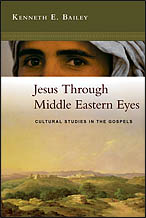 Jesus lived and taught where most military men and women are serving. Kenneth Bailey’s book, Jesus Through Middle Eastern Eyes: Cultural Studies in the Gospels, reveals what Jesus’ life and teaching meant to his Middle Eastern audience. His impact on them was often quite different than his impact on Europeans and Americans today.






 http://www.faithandwar.org
 Mark Durie's Blog
 Military Missions Network
 The Christian Fighter Pilot
 The Navy Christian